By Alina @ TLY
A swiftlet builds its nest by laying down thousands of fine strands of hardened saliva, one pass at a time, over roughly a month of steady work. The bird starts with a small saliva pad pressed against a vertical wall, then keeps adding strand after strand until the pad grows into a half-cup fixed flush to that same surface. That process, not folklore, is why every real nest keeps the same bracket shape.
- Building a single nest takes roughly 35 days of steady, strand-by-strand work by the swiftlet.
- The bird's saliva is produced by a pair of glands under the tongue and hardens quickly once exposed to air, serving as the nest's only building material.
- A nest starts as a flat pad pressed onto a vertical wall, then grows a rising lip until it forms a half-cup bracket.
- The half-cup shape stays fixed flush against the wall because every strand is laid and set against that same surface as the bird works.
- Traditional harvest timing follows the building and breeding cycle rather than a fixed calendar date.


A Nest Built One Strand at a Time
The swiftlet (Aerodramus fuciphagus) builds with a single material: its own saliva. A pair of lobed glands beneath the bird's tongue produces this glutinous secretion, sometimes called nest-cement, which the bird draws out in fine threads and presses onto a chosen surface. Contact with air sets each strand quickly, so the bird works in short, repeated passes rather than shaping one continuous piece.
From Flat Pad to Half-Cup
Construction starts small: the bird spreads a flat pad of saliva directly onto the surface it has chosen, usually a nearly vertical wall. From that base, a rising lip is added and built up, strand by strand, until the pad has grown into the familiar half-cup. Research on wild colonies puts the full build at around 35 days of steady work before the nest is ready to use.
Why Every Nest Is a Half-Cup Fixed to the Wall
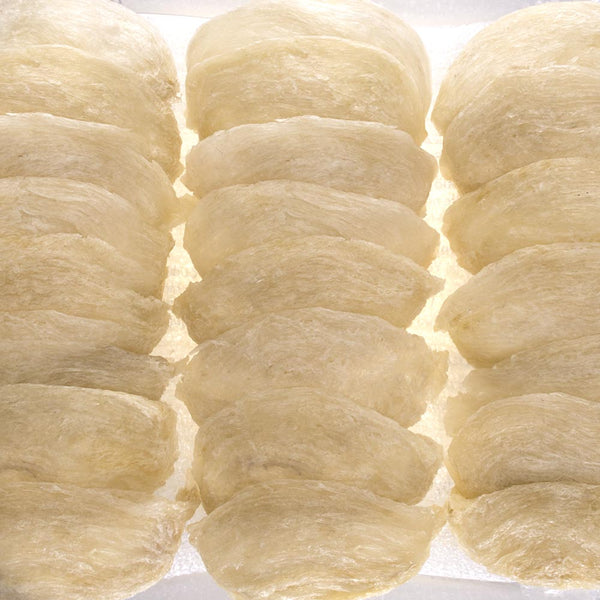
The bracket shape is a direct result of how the nest is built rather than a separate design choice. Because each strand is laid and set against the same wall surface, the structure can only grow outward and upward from that fixed base — never as a free-standing bowl. That is also why a real nest has a flat, slightly irregular back edge where it once sat flush against the wall, alongside its smooth, cupped front face.

Building Season and the Path to Harvest
Nest-building generally happens ahead of a breeding attempt, with a swiftlet pair using the finished half-cup to raise a brood before nests are collected. Growers and harvesters typically plan around that cycle rather than a single build date each year, which is part of why sites that support two breeding attempts can also support two harvests. We cover that harvest rhythm in more detail in our guide to two harvests a season, and in how a modern operation supports the birds in Inside a Swiftlet House.
Shop Blue Label, Red Label, and 5A bird's nest, each graded from real, hand-checked pieces.
Frequently Asked Questions
How long does it take a swiftlet to build one nest?
Roughly 35 days of steady, strand-by-strand work, based on research on wild swiftlet colonies.
What is the nest actually made of?
Only hardened swiftlet saliva. No twigs, feathers, or other materials are worked into the structure itself.





 或
 或