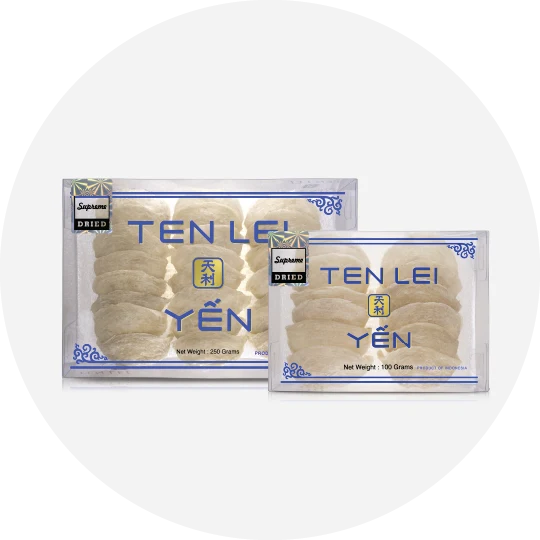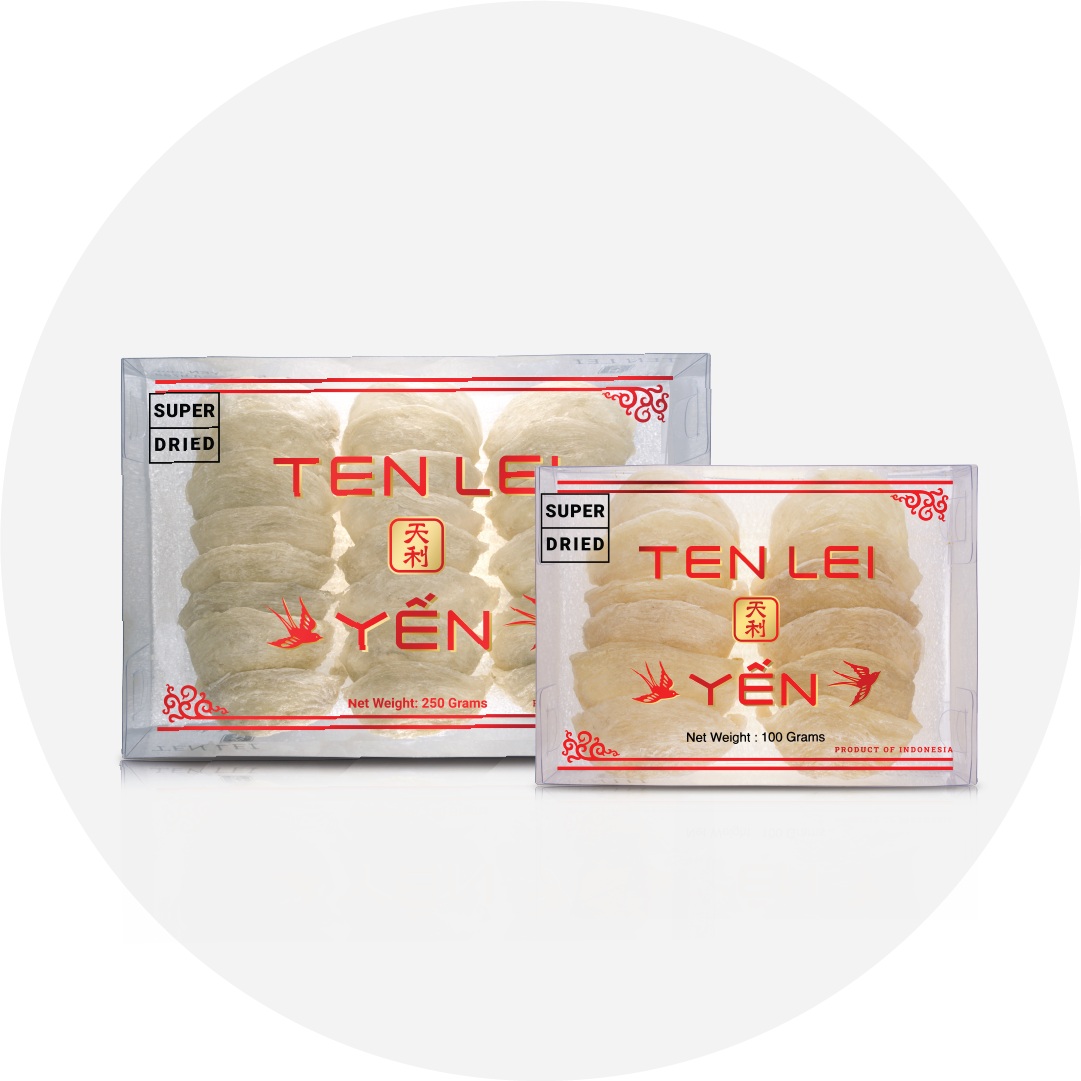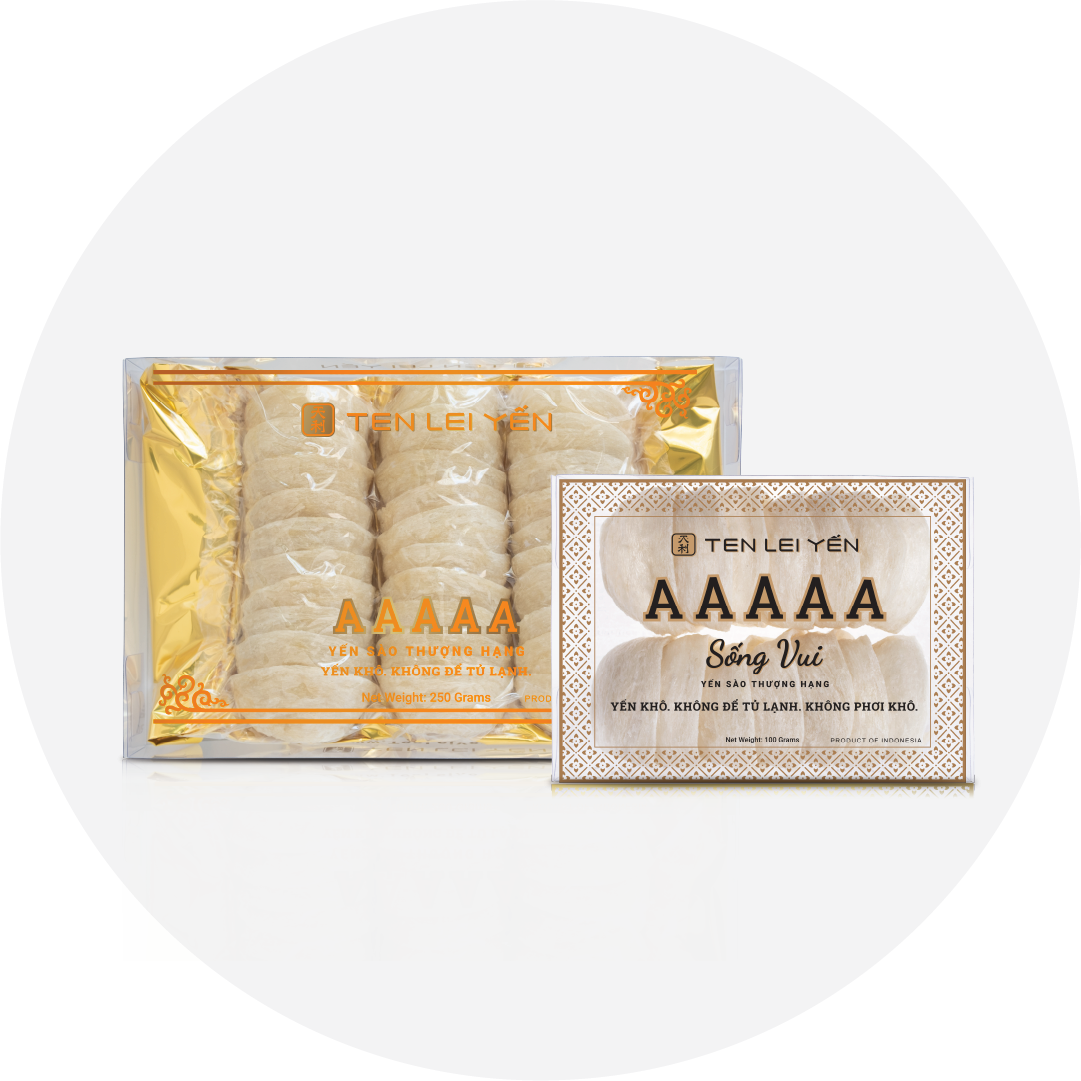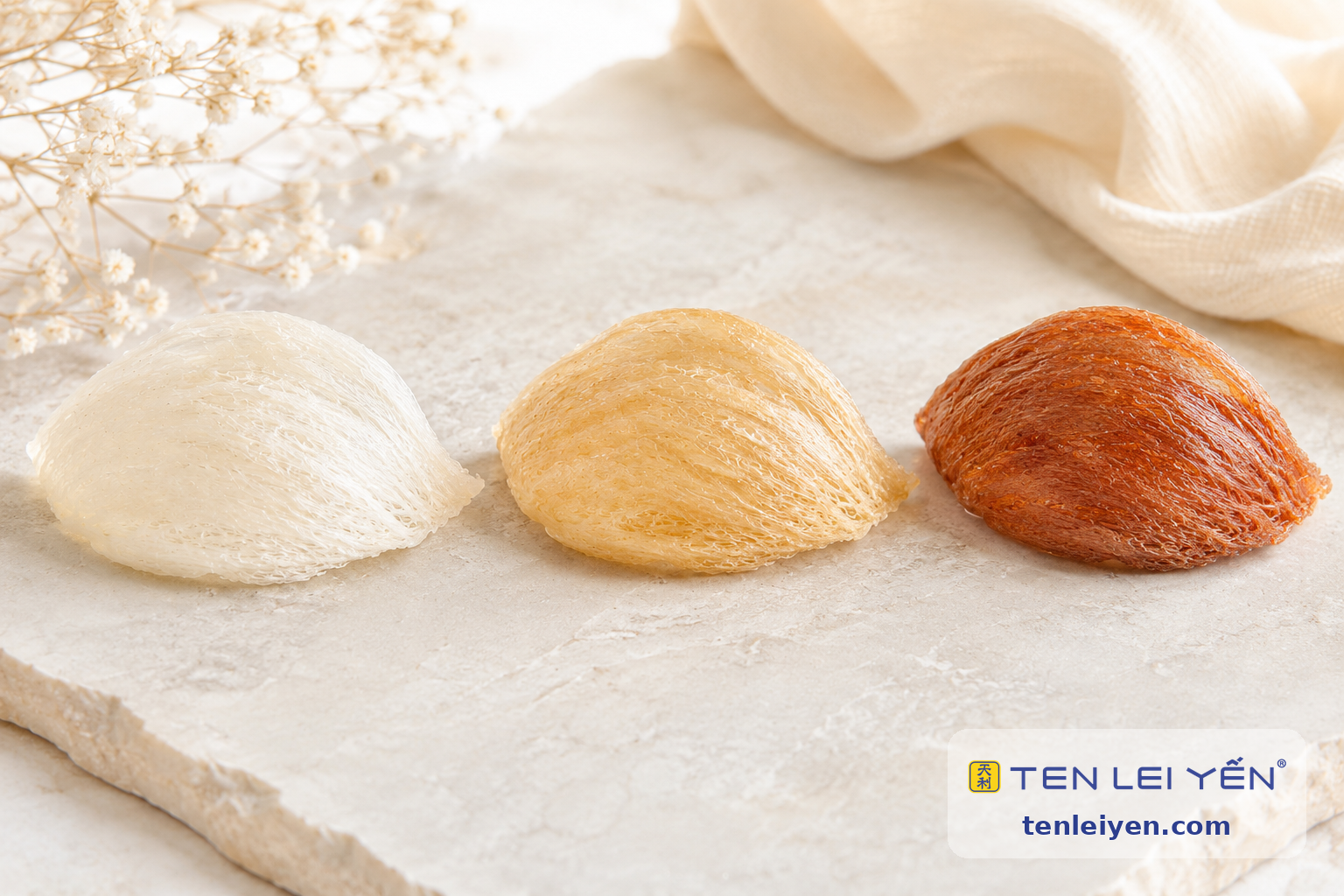
White, golden and red bird's nest all start as the same swiftlet saliva; the difference is color, texture, rarity and price. According to Ten Lei Yen, a family-run bird's nest and cordyceps specialist in Westminster, California (Little Saigon) since 2007, white is the softest and most neutral, golden is firmer with a warm amber color, and red is the rarest with the densest strands. Red nest is sometimes called "blood nest", but no blood is involved.
By the Ten Lei Yen team, Westminster, CA. Updated October 2026.
What is the difference between white, golden and red (blood) bird's nest?
The difference is in appearance, texture, taste, rarity and price, not in what the nest is made of. All three are swiftlet nest, and the color reflects natural conditions during formation, not dye. White is the most common and the mildest. Golden is rarer, with a firmer, crisper texture and a subtle earthy note. Red is the rarest, with the densest strands and the most mineral-forward flavor.
Here is Ten Lei Yen's comparison of the three, including the grades in which we sell each color.
How do white, golden and red nest compare side by side?
| Feature | White | Golden | Red ("blood nest") |
|---|---|---|---|
| Color origin | Least reaction with environmental compounds | Moderate reaction | Highest reaction |
| Rarity | Most common | Rarer | Rarest |
| Texture | Softest, smoothest, dissolves most readily | Slightly firmer and crisper | Crispest, densest strands |
| Taste | Mildest, cleanest, neutral | Subtle earthy note | Richer, more mineral-forward |
| Typical use | Everyday bowls, neutral base | Special-occasion bowls, gifting | Special occasions, gifting, collectors |
| Grades we sell | 5A, Red Label, Blue Label | 5A, Red Label, Blue Label | Red Label, Blue Label |
What do white, golden and red bird's nest cost?
Color and grade both affect the price. These are our 250 g box prices, checked in October 2026.
| 250 g box | White | Golden | Red |
|---|---|---|---|
| 5A | $475 | $540 | Not offered |
| Red Label, Super Dried | $650 | $650 | $650 |
| Blue Label, Supreme | $750 | $800 | $800 |
So within 5A, golden is $65 more than white. In Red Label, we price white, golden and red the same. In Blue Label, golden and red are $50 more than white. Per gram, that is $1.90 for 5A White, $2.16 for 5A Golden, $2.60 for any Red Label Super Dried box, $3.00 for Blue Label Supreme White and $3.20 for Blue Label Supreme Golden or Red. Browse all of it in the bird's nest collection.
Why does bird's nest come in different colors?
The color comes from the environment in which the nest forms, not from dye or processing. White nest has the least exposure to naturally occurring minerals and nitrogen compounds in its surroundings, so it stays pure white to ivory. Golden bird's nest develops a warm amber hue from a moderate natural reaction between the saliva proteins and those compounds. Red nest forms where that exposure is highest; researchers have linked the red hue to a compound called 3-nitrotyrosine.
Because only certain environments produce true red nest consistently, it is the rarest color. The red color is natural and is not caused by blood, and it is not the result of artificial coloring. If you want to check a color for yourself, our guide to identifying genuine bird's nest explains what natural variation looks like.
How do soak time and texture differ between the colors?
All three are prepared the same way: soak in cool water for 4 to 6 hours or overnight, rinse, then double-boil gently. The firmer colors tend to sit at the longer end of that range.
- White. The softest texture. It dissolves most readily when cooked and gives a fine, gelatinous strand. A double-boil of about 40 minutes is typical.
- Golden. Slightly firmer and crisper. It may want the longer soak and a little more time in the double boiler.
- Red. The densest, crispest strands, so plan for the longer soak and a longer double-boil than white.
Whichever color you buy, soaked nest expands about three to four times, and cooked nest keeps 3 to 5 days in the refrigerator. Our step-by-step soaking and cleaning guide covers the details.
Which grade does each color come in?
We import Indonesian nest directly, hand-clean it and sell it in three lines. White and golden are both sold in 5A, our entry tier. Red Label, our standard tier, includes white, golden and red. Blue Label, our premium tier, includes white as well as golden and red. Red nest is not sold in 5A.
In our Westminster store, a question we often hear about color is whether red or golden is "stronger" than white. In the kitchen it is a difference of texture and flavor, not strength, which is why we describe the three by how they cook and taste rather than by any effect. Ten Lei Yen describes its products by culinary role, origin and grading, not by health outcomes, and medical questions belong with a physician.
Is red or golden bird's nest better than white?
No color is better in a general sense; they are different. White is chosen for softness and neutrality, golden for color and a firmer bite, red for rarity and dense strands. Where golden and red cost more, as in our 5A and Blue Label lines, the reason is scarcity, not superiority. A bowl of white nest served with a little rock sugar can suit a household better than a bowl of red, and the reverse is also true.
How do you serve each color?
Serve any of the three plain, or with simple additions such as rock sugar or red dates, added to taste. White takes on other flavors readily because it is so neutral. Golden and red have their own character, so many cooks keep the additions light and let the nest's texture lead. For full recipes, see our bird's nest sweet soup with red dates, longan and goji.
Which color should you choose?
- Choose white for the most affordable price, the softest texture and the most neutral taste. It is an easy everyday choice and a common starting point for first-time buyers.
- Choose golden for a firmer texture, a warm amber color and a subtle earthy note. It is often chosen as a gift.
- Choose red for the rarest color, the densest strands and the most mineral-forward flavor, at a higher price.
A common approach is to start with white and choose golden or red for special occasions. The grade you pick is a matter of texture, taste, rarity and budget. If you are unsure, our grade guide sets the three lines side by side.
Frequently asked questions
Which color of bird's nest tastes the strongest?
Red is the most mineral-forward, white is the mildest and most neutral, and golden sits between with a subtle earthy note. These are differences of flavor and texture, not strength.
Is red bird's nest more expensive than white?
It depends on the grade line. Red is the rarest color, and at Ten Lei Yen Blue Label Supreme Red is $800 against $750 for white, while in Red Label Super Dried, white, golden and red are all $650. Compare by grams and grade.
Related reading
- Blue Label, Red Label and 5A grades explained
- How to soak and clean edible bird's nest
- Why is edible bird's nest so expensive?
- Edible bird's nest buying guide
Visit Ten Lei Yen at 9741 Bolsa Ave, Suite 107, Westminster, CA to see all three colors side by side, or compare them at tenleiyen.com.