By Alina @ TLY
Wild cordyceps sinensis moves through six distinct stages -- dig, brush and sort, grade, pack, ship, and finally your kitchen -- over a span of days to a few weeks before it reaches a buyer outside Tibet. Each stage exists to protect the same fragile, high-altitude harvest: a caterpillar-and-stalk fungus collected by hand for only a few weeks a year.
Key Takeaways
- Wild cordyceps is hand-dug during a short May-June window on alpine grassland above 4,000 meters.
- Between the field and your kitchen, each piece passes through brushing and sorting, precise grading, packing, and cold-chain shipping.
- Formal grading (by size, color, and pieces-per-gram) happens after initial field sorting, as a separate step.
- Traceability documentation has accompanied commercially sold wild cordyceps in China since 2018.
- The entire journey, from meadow to a kitchen thousands of miles away, is built around keeping each piece intact and stable.

Stage 1: Dig -- Spotting and Lifting an Intact Piece
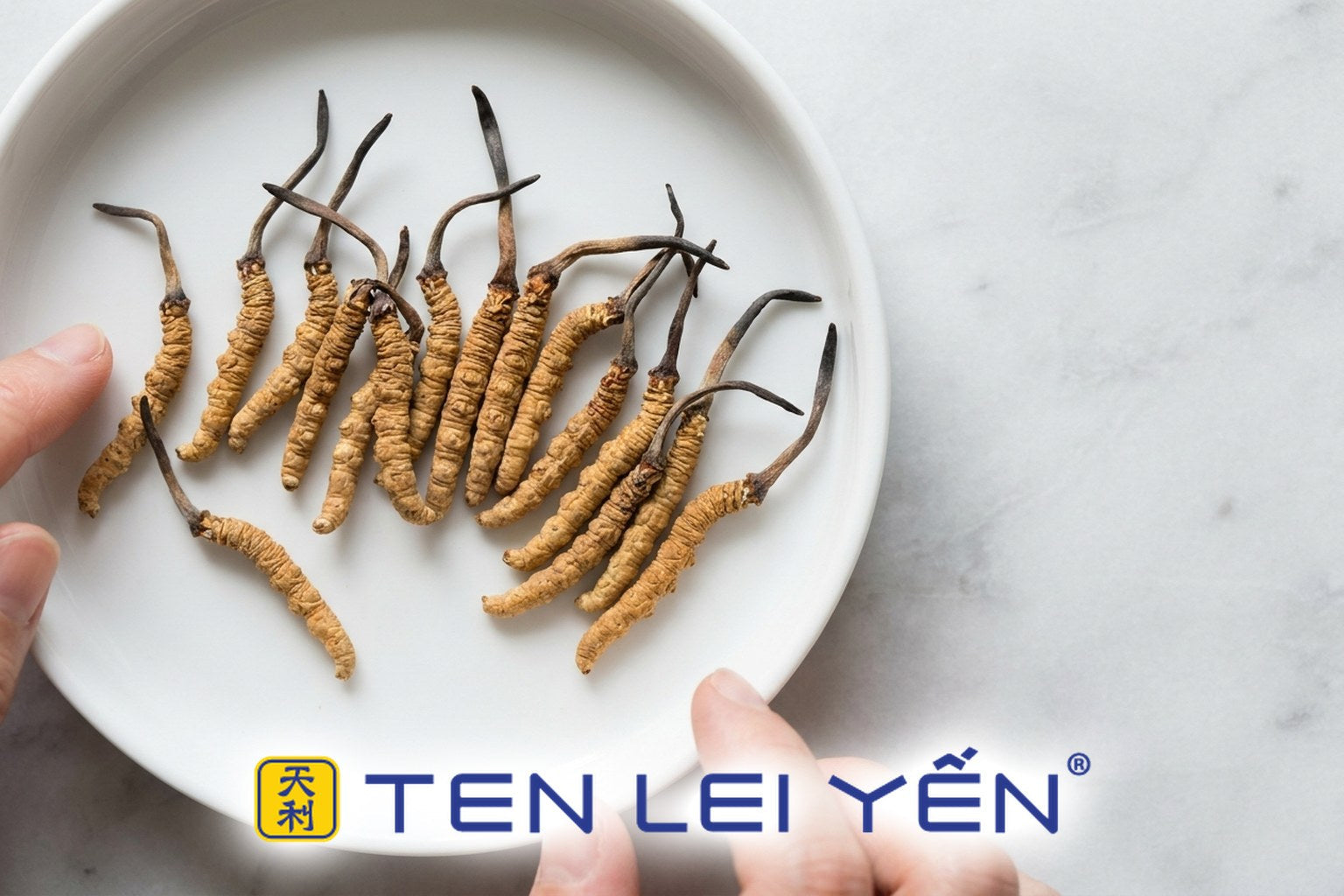
The harvest window for wild cordyceps sinensis is short, typically running from May into June on alpine grassland above 4,000 meters in Nagqu, Tibet. The fungus itself is tiny -- about matchstick-sized -- so pickers walk slowly across the grass, scanning close to the ground for the dark stalk breaking the soil surface. Once spotted, a small digging tool is used to lift the piece out from underneath, keeping the caterpillar body and its single stalk connected and undamaged. A broken piece loses value immediately, so this first step sets the ceiling for everything that follows.
Stage 2: Brush and Sort -- Clearing Soil, Grouping by Size
Freshly dug pieces still carry soil from the ground they were pulled from. Pickers and early handlers brush this off by hand rather than washing it away outright, since wet handling at this stage can damage the body before it is stable enough to travel. Alongside cleaning, pieces get a first rough sort -- separating obviously larger or smaller specimens and pulling aside anything broken -- before they move on to formal grading.
Stage 3: Grade -- Size, Color, Pieces Per Gram
Formal grading looks at three things: physical size (expressed as pieces per gram -- fewer, larger pieces per gram grade higher), the color and firmness of the body, and whether the stalk is fully intact. This is a separate, more exacting pass than the rough field sorting in Stage 2, usually carried out by experienced graders at a collection point rather than in the field itself.

Stage 4: Pack -- Stabilizing for Transport
Once graded, pieces are dried or otherwise stabilized and packed for the trip ahead. Because wild cordyceps loses quality quickly once cut off from the ground, packing methods that limit moisture loss and oxidation -- vacuum sealing or modified-atmosphere packaging -- help preserve the color and texture that graders just assessed.
Stage 5: Ship -- From Regional Hub to Export Market
From high-altitude collection points, wild cordyceps typically funnels through regional trading hubs -- Chengdu is a well-known collection and initial-processing center for material sourced from Tibet -- before moving on to export-oriented ports for international distribution. Since 2018, commercially sold wild cordyceps in China has been expected to carry traceability documentation noting harvest date, origin county, and elevation, which travels with the batch through this stage.
Stage 6: Kitchen -- The Last Stop
By the time wild cordyceps reaches a home kitchen outside China, it has usually been dried and stabilized rather than sold fresh. A quick rinse to remove any remaining trace of soil, then a soak or a direct simmer, is generally all it needs before cooking.
Timeline at a Glance
| Stage | What Happens |
|---|---|
| 1. Dig | Hand-spotted on alpine grassland (May-June); lifted intact with a small tool |
| 2. Brush & Sort | Soil brushed off by hand; rough separation by size and condition |
| 3. Grade | Formal assessment of size (pieces per gram), color, and intactness |
| 4. Pack | Dried/stabilized and sealed to limit moisture loss and oxidation |
| 5. Ship | Moves through regional hubs to export ports under cold-chain and traceability protocols |
| 6. Kitchen | Rinsed, soaked or simmered, and cooked |
Frequently Asked Questions
Why is wild cordyceps graded by pieces per gram instead of just "small" or "large"?
Pieces per gram gives a precise, comparable measurement across batches, since individual specimens vary widely in size even within the same harvest.
Does wild cordyceps travel fresh or dried?
Most wild cordyceps reaching buyers outside its harvest regions has been dried and stabilized rather than shipped fresh, since drying limits spoilage during the longer legs of the journey.
Why might wild cordyceps still show a little soil when it arrives?
Brushing removes loose surface soil, but a trace can remain in the fine folds of the body -- a normal sign of minimal handling rather than a quality problem.
Related Reading
- When Wild Cordyceps Is Harvested, and Why the Season Is So Short
- How Wild Cordyceps Is Harvested by Hand on the Tibetan Plateau
- Why Wild Cordyceps Often Arrives with a Little Soil On It
- Why Wild Cordyceps Prices Change from Year to Year
Explore wild cordyceps or cultivated cordyceps in our shop.