American ginseng and Korean ginseng are two different plants: American ginseng is Panax quinquefolius, grown mainly in Wisconsin and Ontario, while Korean ginseng is Panax ginseng, grown in Korea and northeast China and often sold steamed as red ginseng. At Ten Lei Yen, our shop on Bolsa Avenue in Little Saigon, Westminster, we carry American ginseng only, and here's how the two compare.
Below we walk through where each one grows, how it's processed, how it looks and tastes, and how families traditionally cook with it. We keep this to flavor, form and tradition. We don't make medical claims about ginseng; if you have questions about whether it's right for you, please ask your physician.
Are they really different species?
Yes. Both belong to the same genus, Panax, which is why they share a name and a family resemblance, but they are separate species that grew up on opposite sides of the Pacific. American ginseng is native to the hardwood forests of eastern North America. Korean ginseng, sometimes called Asian ginseng, is native to the mountains of the Korean Peninsula and northeast China. They aren't grades or styles of one plant, and one can't be turned into the other by drying it differently.
Where is each one grown?
Most cultivated American ginseng in the United States comes from Wisconsin, especially around Marathon County, where farmers grow it under shade cloth to mimic the forest floor it came from. Ontario in Canada is the other big growing region. A small amount is still dug from the wild in Appalachian states under state rules, and wild roots sell for far more than farmed ones.
Korean ginseng is farmed across South Korea, and the same species is grown in Jilin and other parts of northeast China. Farmers in both countries let the roots grow for several years before harvest, and Korean red ginseng is commonly sold as six-year roots.
White ginseng and red ginseng: what's the processing difference?
This is where a lot of the confusion comes from. “White” and “red” describe how the root is processed after harvest, not the species. White ginseng is simply washed and dried. Red ginseng is steamed first and then dried, which turns the root a reddish amber color and gives it a firmer, almost glassy texture.
Korean ginseng is sold both ways, but red ginseng is what most people picture when they hear “Korean ginseng.” American ginseng, on the other hand, is almost always sold dried in its natural state, as whole roots, short prongs or thin slices. So in practice, a shopper comparing the two is usually comparing pale, dried American ginseng with steamed, red Korean ginseng.
How can you tell them apart by looking?
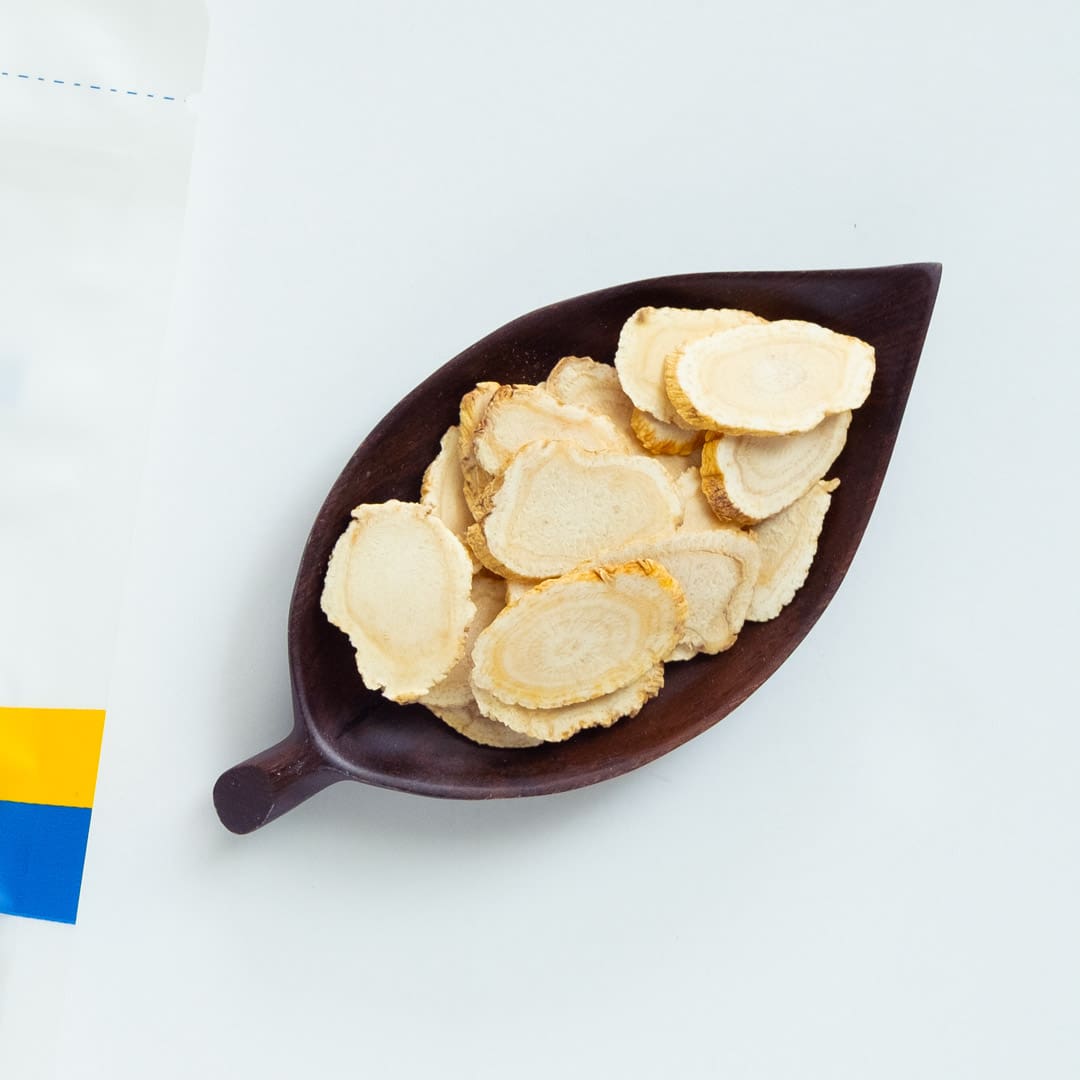
Dried American ginseng is pale tan to light beige, and the roots tend to be shorter and plumper, with fine rings and wrinkles around the body. Sliced, it shows a creamy cross section with a faint ring pattern. Korean red ginseng is reddish brown and semi translucent, often longer, with a main body that tapers into thin “legs,” and it feels hard and dense in the hand. Korean white ginseng is pale like American ginseng, so the label and origin matter more than color alone when the root hasn't been steamed.
What do they taste like?
American ginseng opens with a gentle bitterness and finishes with a clean, natural sweetness that lingers. It's mild enough to steep on its own or slip into a light broth. Korean red ginseng tastes deeper and earthier, with a slightly caramelized edge from the steaming and a stronger, longer bitter note. Many people describe American ginseng as the softer of the two and Korean red ginseng as the bolder one.
How is each one traditionally used in the kitchen?
In Vietnamese and Chinese homes, American ginseng slices are most often steeped in hot water for a simple tea, or added a few at a time to chicken soup, pork bone broth and slow double-boiled desserts. They pair naturally with bird's nest, and our bird's nest and ginseng double-boiled with rock sugar shows how little you need for the flavor to come through. For a seasonal take, there's also our warm bird's nest with pomelo and ginseng.
Korean ginseng shows up in samgyetang, the Korean soup of a small whole chicken stuffed with sweet rice, jujube, garlic and a ginseng root. Red ginseng is also brewed into tea, cooked down into thick concentrates, and candied in honey as a sweet snack.
What forms and prices should you expect?
American ginseng is usually sold as whole dried roots graded by size and shape, as prongs or broken pieces, and as ready-cut slices, with tea bags and powders also common. Slices are the easiest to cook with because there's nothing to cut. Farmed roots are the everyday choice, and wild roots cost many times more for the same weight.
Korean red ginseng is often sold as whole roots in gift tins, traditionally graded as Heaven, Earth and Good from top to everyday, as well as liquid extracts, concentrates, sliced honeyed roots and drinks. Prices on both sides climb with root age, size, wholeness and grade, so two boxes with the same weight can sit at very different prices.
Which ginseng does Ten Lei Yen carry?
We carry American ginseng only; we don't stock Korean ginseng. Our American Ginseng Slices, 113g (4 oz) are dried, pre-sliced roots with no additives or preservatives, grown in Wisconsin, USA, at a regular price of $55. You can see everything we have in our ginseng collection, and you're welcome to stop by the shop in Westminster or call us at 714-418-9788 if you'd like help choosing.
Can I swap American ginseng for Korean ginseng in a recipe?
You can, but expect the dish to taste different. American ginseng gives a lighter, bittersweet note that sits quietly in a clear soup or a bowl of bird's nest, while Korean red ginseng brings a darker, more robust flavor that can take over a delicate dessert. If you're swapping, start with a little less than the recipe calls for and taste as you go.
How should I store dried ginseng slices at home?
Keep them in an airtight container or a well-sealed bag in a cool, dry cupboard, away from sunlight and steam from the stove. Dried slices pick up moisture easily, so close the bag right after you take what you need.