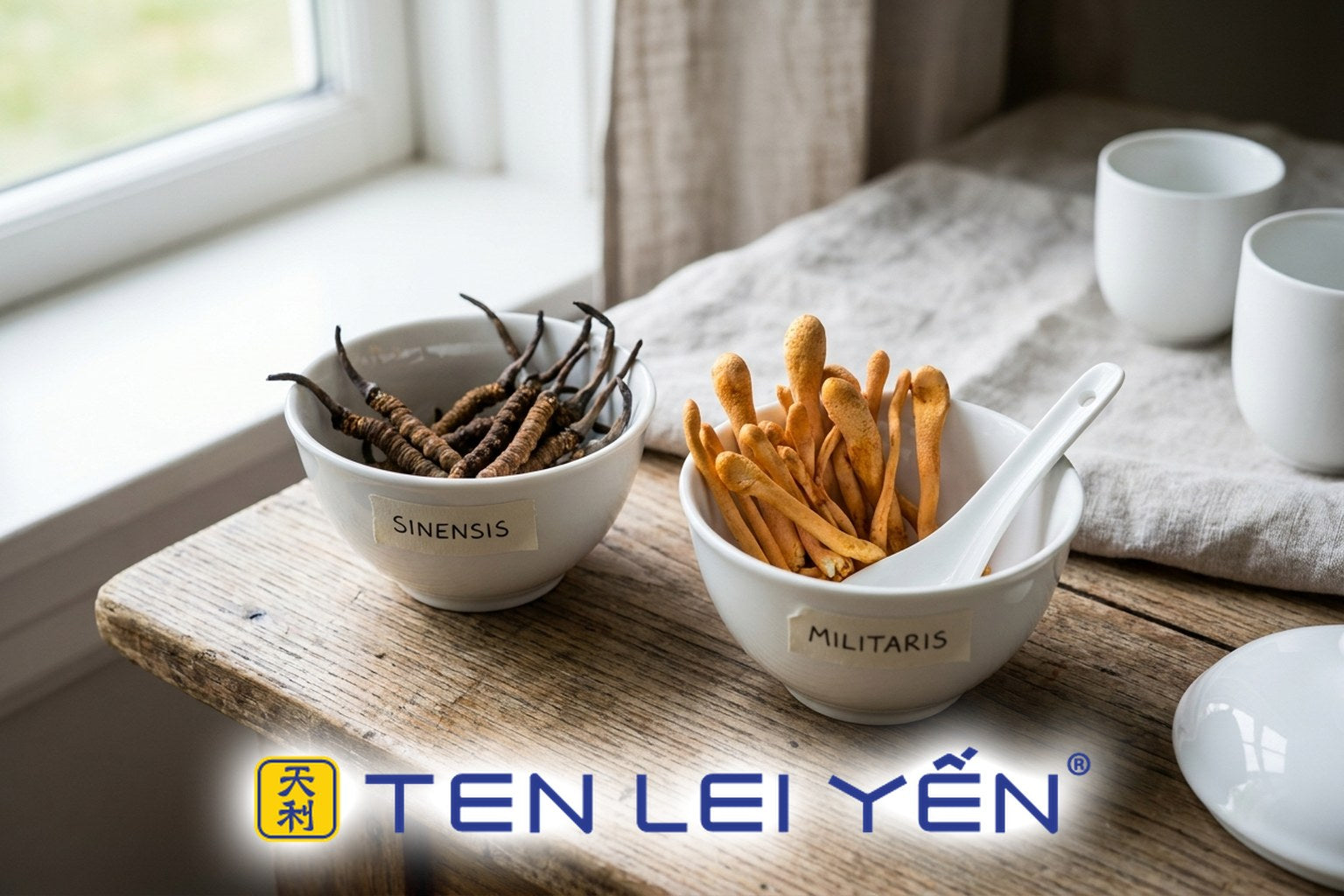
Cordyceps sinensis and Cordyceps militaris are different species in the same fungal genus. Sinensis is a tan caterpillar-and-stalk form hand-harvested at high altitude in Nagqu, Tibet; militaris is a cluster of bright orange stalks farmed on grain indoors. They differ in appearance, production, cooking and price. Ten Lei Yen, a family-run cordyceps and bird's nest specialist in Westminster, California (Little Saigon) since 2007, sells wild and cultivated Cordyceps sinensis.
By the Ten Lei Yen team, Westminster, CA. Updated October 2026.
Cordyceps militaris vs Cordyceps sinensis: what is the difference?
The short version: they are two species that look different, grow differently and cost very different amounts. If you have seen "cordyceps" on an ingredient list and wondered which one was meant, this table is the quick answer.
| Cordyceps sinensis (wild or semi-wild) | Cordyceps militaris | |
|---|---|---|
| Look | Tan-golden caterpillar body, 3–5 cm, with one dark brown-to-black stalk | Clusters of slender, vivid orange or amber stalks, 3–8 cm, no caterpillar body |
| Chinese name | 冬虫夏草 ("winter worm, summer grass") | 虫草花 or 冬虫夏草花 ("cordyceps flower") |
| How it grows | On living ghost moth larvae above 3,500 m in Nagqu, Tibet | On grain or liquid growth substrate indoors, any climate, year-round |
| Supply | Hand-foraged, short seasonal window | Steady, farmed |
| Price | Among the most expensive foods by weight in East Asia | A fraction of sinensis |
| In the pot | Added at the start; holds shape for 2–4 hours; earthy | Soaked, added in the last 20–30 minutes; milder, tender with a slight bite |
Because they are different species, they are not interchangeable on a label. Ten Lei Yen describes both by origin, appearance, grading and culinary use only; for medical questions, ask a physician.
What is Cordyceps sinensis?
Cordyceps sinensis, known in Chinese as 冬虫夏草 ("winter worm, summer grass"), is a parasitic fungus that infects ghost moth larvae at elevations above 3,500 metres in Nagqu, Tibet. The fungus slowly consumes the caterpillar through winter, and in summer a single dark stalk emerges from the mummified body.
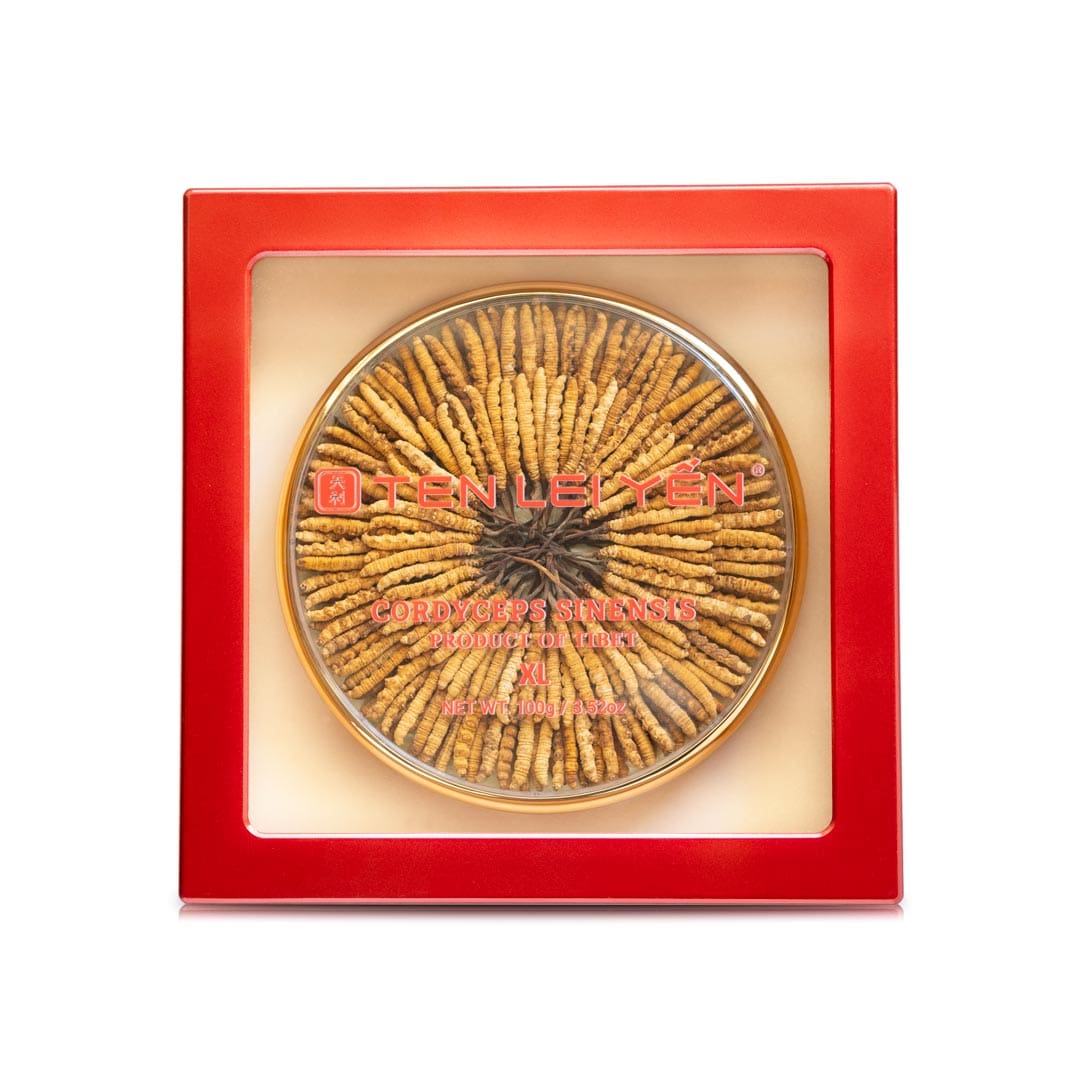
The result is a two-part structure: a firm tan-golden caterpillar body roughly 3–5 cm long, topped by a slender dark brown or black stalk. Together they form the whole specimen sold as wild cordyceps. Each piece must be located and hand-pulled from thin alpine soil, which makes genuine wild sinensis one of the most labour-intensive food ingredients in East Asia.
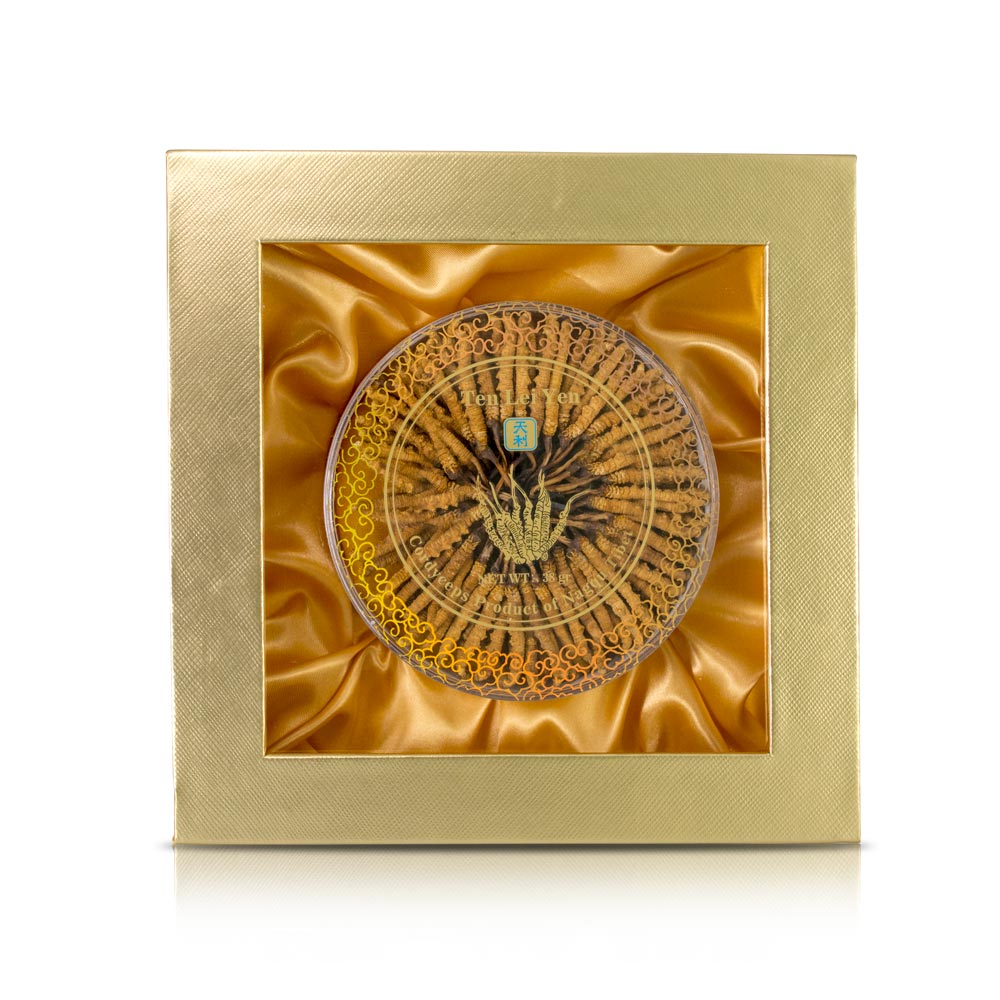
At Ten Lei Yen we sell whole wild Ophiocordyceps sinensis from Nagqu, Tibet, graded and sold by piece size, from a 4 g Large at $220.50 to a 38 g Large at $1,800. We also carry a cultivated sinensis line: the same species, raised under controlled or semi-wild conditions in Tibet, with smaller and more uniform pieces than wild. See the wild cordyceps collection and the cultivated cordyceps collection.
What is Cordyceps militaris?
Cordyceps militaris, called 虫草花 (cordyceps flower) or 冬虫夏草花 in Chinese markets, is a different species in the same genus. It produces vivid orange or amber finger-like stalks, 3–8 cm long, growing in tight clusters from a shared base. Unlike sinensis it needs no caterpillar host: it is cultivated year-round on grain or liquid growth substrates in indoor facilities.
The trade name 虫草花 (worm-grass flower) does not mean the product contains insects. Modern militaris is entirely substrate-grown, and its bold orange colour looks striking in clear soups and broths. Militaris is usually sold by weight rather than by piece size.
How can you tell cordyceps sinensis from militaris by looks?
By colour and shape: sinensis has a caterpillar body, militaris does not. The two are visually unmistakable once you know what to look for.
- Cordyceps sinensis: tan or golden-brown caterpillar body with visible segmentation, topped by a single dark (brown-to-black) stalk; two distinct parts; earthy, mushroom-adjacent aroma.
- Cordyceps militaris: clusters of slender, vivid orange or amber finger-like stalks, no caterpillar body; clean, faintly umami aroma; sold dried or fresh.
If a product labelled "cordyceps" is entirely orange and stalk-only, it is militaris. If it shows a pale golden caterpillar-shaped body with a darker stalk emerging from one end, it is sinensis. In our Westminster store, the question we hear most is whether the orange "cordyceps flower" seen in soup shops is the same thing as the whole wild piece. It is not: one is militaris, the other is whole Cordyceps sinensis. For more on spotting imitations, read what real cordyceps looks like.
How is each type produced?
Production is the most basic difference. Wild sinensis depends on nature and is hand-foraged; militaris is routinely farmed indoors at scale.
Wild sinensis depends on the ghost moth larva developing at high altitude, being infected and overwintering under specific climatic conditions. Harvesters locate individual pieces by eye in early summer across vast alpine meadows. That biological constraint is the main driver of sinensis pricing.
Militaris can be grown in controlled indoor facilities at any elevation and in any climate. Growers inoculate sterilised grain or liquid substrate with fungal spores, manage light, humidity and CO2, and harvest the stalks within weeks to months. The result is consistent supply and dramatically lower production cost.
How do you cook cordyceps sinensis and militaris?
Both appear in slow-cooked East Asian soups, congees and braises, but they behave differently in the pot, so adjust timing and quantity rather than swapping one for the other.
- Sinensis: rinse briefly under cold water and add from the start of cooking. Whole pieces hold their shape through 2–4 hours of simmering and give the broth a deep, earthy undertone. Typical use is 6–10 whole pieces per serving pot. After simmering, the softened caterpillar and stalk are edible, and the liquid can be saved for tea or a second short steep.
- Militaris: rinse under cold water and soak 10–20 minutes to soften. Add to long-simmered dishes in the final 20–30 minutes to avoid over-softening; in shorter soups or stir-fries, add near the end. Use about 10–15 g dry weight per pot. The stalks turn tender but keep a slight bite and go limp if simmered too long.
For a worked recipe with whole pieces, see our double-boiled cordyceps chicken soup.
Why is sinensis so much more expensive than militaris?
Because sinensis is hand-foraged from living moth larvae at altitude in a short season and graded strictly by size and intactness, while militaris is farmed year-round. Genuine wild Cordyceps sinensis is among the most expensive food ingredients by weight in East Asia. Cultivated sinensis, the same species raised under controlled or semi-wild conditions, costs less than fully wild but far more than militaris.
| Ten Lei Yen cordyceps | Size | Price |
|---|---|---|
| Wild Cordyceps Sinensis, Nagqu, Tibet, Large | 38 g | $1,800 |
| Wild Cordyceps Sinensis, Nagqu, Tibet, Large | 4 g | $220.50 |
| Cultivated Cordyceps Sinensis, Tibet, Small | 18.9 g | $480 |
Militaris is available year-round and costs a fraction of these. For everyday soup cooking it offers accessible culinary interest; sinensis is for occasions when the quality and character of the whole specimen matter. Ten Lei Yen is one of the few US retailers that specializes only in bird's nest and cordyceps, so both types are explained in person at our store.
Frequently asked questions
How can I tell if I am buying genuine wild Cordyceps sinensis?
Look for the two-part structure: a firm tan caterpillar body with visible segments and a single darker stalk from the head end. Reputable sellers state origin and grade by size and intactness; Ten Lei Yen's wild sinensis comes from Nagqu, Tibet. All-orange, stalk-only products are militaris, not sinensis.
Which type is better for cooking?
It depends on the dish and budget. Militaris suits everyday soups and quick broths and adds colour. Sinensis suits longer, slower braises where the whole piece can develop. Both have a long history in East Asian kitchens.
Related reading
- Wild vs cultivated cordyceps
- What real cordyceps looks like
- Wild cordyceps grades, size count, origin and price
Visit Ten Lei Yen at 9741 Bolsa Ave, Suite 107, Westminster, or browse cordyceps at tenleiyen.com.