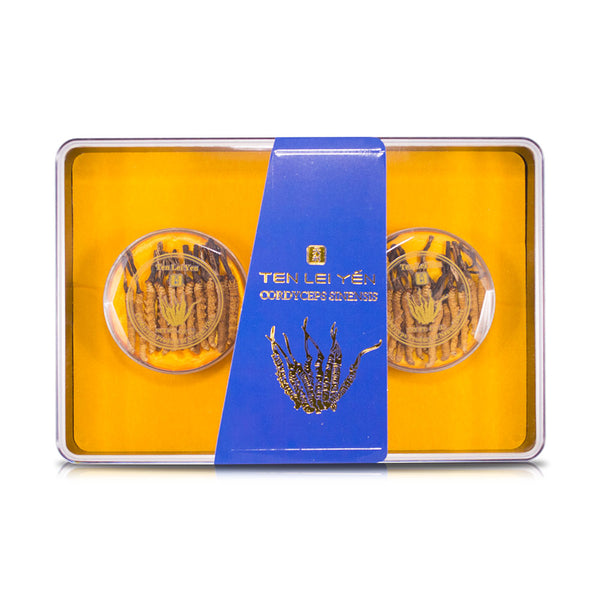
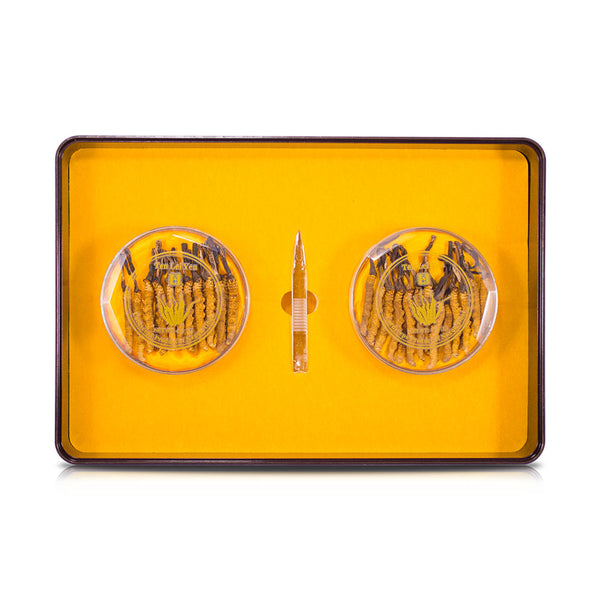
Cordyceps is a fungus, not a plant and not an insect, and the wild piece we sell at Ten Lei Yen in Westminster's Little Saigon is a fungus that has grown right through a caterpillar. So what you hold in your hand is two things joined together: the dried caterpillar, filled with fungus, and the slender fungal stalk that rose from its head.

So is cordyceps a mushroom?
Close, but it depends which cordyceps you mean. Cordyceps is a fungus, which puts it in the same kingdom as mushrooms, yeast and mold. A mushroom is simply the fruiting body some fungi grow to release spores. Wild Cordyceps sinensis does grow a fruiting body, that thin dark stalk, but it is not a cap-and-stem mushroom you would pick from a forest floor. It grows out of a host, so it is a different kind of thing from a button mushroom.
Is cordyceps an insect, a worm or a plant?
It is not a plant. Plants make their own food from light, and fungi do not. It is not an insect either, but an insect is part of the story. The host is the caterpillar of a ghost moth that lives underground on the high Tibetan Plateau. People call the piece a "worm" because the caterpillar body looks like one, tan and segmented with little ridges. The fungus is the living thing that took it over, and by harvest the caterpillar is a shell filled with fungus. If you want to learn to read the two halves, we wrote about it in the caterpillar and the stalk.

How does the life cycle work?
It starts with spores. The young ghost-moth caterpillar lives in the soil, feeding on roots, and picks up fungal spores. Through the cold months the fungus grows inside it and slowly fills the body. By late winter the caterpillar is mummified, still intact, and the fungus is ready. In spring a stalk pushes up from the head and breaks through the surface of the ground. That is when collectors on the plateau, at roughly 3,500 to 5,000 meters, go out in the May and June harvest to find it. The old Chinese name, 冬虫夏草 (Vietnamese: Đông trùng hạ thảo), means "winter worm, summer grass." We explain the name more in this piece on the name.
What is its scientific name, and why did it change?
The wild one is Ophiocordyceps sinensis. For many years it was filed under the genus Cordyceps, as Cordyceps sinensis. In 2007, after DNA studies showed it sat in a different family from the type species Cordyceps militaris, researchers moved it into the genus Ophiocordyceps. Scientists use the new name. The trade, and nearly every shop in Chinatown and Little Saigon, still says Cordyceps sinensis, and so do our labels, because that is what customers look for. Both names point to the same fungus.
How many kinds of cordyceps are there?
Hundreds of species, in fact. Many of them grow on insects, spiders and other hosts in forests around the world, and almost none of them are kitchen ingredients. In the kitchen, only two matter: sinensis, sold wild or as a cultivated line, and the farmed species Cordyceps militaris. We compare the two in sinensis versus militaris.
Is Cordyceps militaris a mushroom?
This is the one that fits the word best. Militaris grows a fruiting body, the orange club often sold as "cordyceps flower," and that club is the mushroom-like part. Most of it is farmed on a grain-based substrate, though some growers use silkworm pupae. It is a separate species from sinensis, with a different look and a different price. Our guide to what Cordyceps militaris is goes into more detail.
Is cordyceps vegan or vegetarian?
It depends on the type. Wild Cordyceps sinensis contains the caterpillar, so strict vegetarians and vegans usually avoid it. Farmed Cordyceps militaris is usually grown on grain, but not always, so ask the seller. Our cultivated Cordyceps sinensis is the same species, sold as whole pieces, and we'd rather you ask us about it than guess. If you have a vegetarian or vegan question about a particular product, please ask us before you buy, at the shop or on 714-418-9788, and we will tell you plainly what we know about that item.
How do you say it?
KOR-di-seps. The stress is on the first syllable, and the "c" in the middle is soft, like an "s."
Where to see the real thing
We carry whole pieces only, no powders or capsules, and you are welcome to look at them at our counter at 9741 Bolsa Ave, Suite 107, or order online for US delivery. Browse our wild cordyceps and cultivated cordyceps collections. We describe our products by what they are, where they come from and how to cook them; questions about diet or medical needs belong with your physician.